De Fabel van de illegaal, 1999 - 2001

Authors: Various


Militant actions against Leyden's colonial war monument

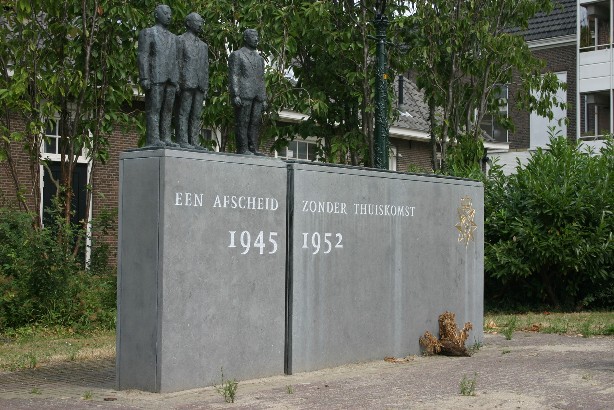
In October 1999 a monument was erected to remember the soldiers from Leyden who died in the colonial war against Indonesian independence. Until Spring 2001 the monument was attacked by night at least 4 times by several unknown militant action groups. Except for these militant actions there were no other protests at all. However, some progressive council members did seem to feel a bit uneasy with the newly erected monument. De Fabel van de illegaal received elaborate press statements of the militant groups and published them in their anti-racist magazine. These texts are now translated because they give some insight into Dutch colonialism and the way the government and much of the Dutch population now look back at colonialism.
1. Action by action group Merdeka
(published in De Fabel van de illegaal no 37, January 2000)

On October 23, 1999, veterans who have fought in "Indië" (as the Dutch used to call their Indonesian colony) revealed a monument consisting of three little figures to remember their 40 Leyden colleagues who have died in the war from 1946 to 1949 against the Indonesians. In a nightly action two days earlier, action group Merdeka (meaning Freedom in Indonesian) had thrown all three statues in the nearby moat. "We think that in stead of the Dutch military, the hundreds of thousands of Indonesians and millions of other victims of Dutch colonialism should be remembered", the group wrote in a statement that also reached De Fabel. Here's the complete text.

The successive governments of prime ministers Beel and Drees waged a colonial war on Indonesia from 1946 to 1949 using the slogan "Indies lost, disaster born". A horrendous war against people who were for a long time dominated by the Dutch colonial powers, and who had founded the Indonesian republic in 1945 at the beginning of the anti-colonial struggle for freedom. "For 300 years we have ruled here with klewang and club, and we will so in 300 years", governor general of the Dutch Indies B.J. de Jonge had said in 1936. De Jonge was one of the last administrators who was send by the Dutch state to rule in the usual manner since the first colonial exploitators - the Verenigde Oostindische Compagnie (VOC, first Dutch colonial corporation): "The colonies are there for the motherland, the motherland is not there for the colonies".

Operation Product

The Dutch government refused to call the military actions a war, but rather spoke of a "police action of a strictly limited character". This euphemism was made up by Van Kleffens, in those days Dutch ambassador to the United States. He did so "to avoid unpleasant reactions from abroad". The Dutch government very well understood that this war would produce much protest from abroad and at home. The government had it's military kill a 100.000 to 150.000 Indonesians. On the Dutch side 6.200 military were killed, among whom the 40 Leyden soldiers. These 40 soldiers are remembered with the monument, and not the ten of thousands of Indonesian soldiers who died during this war.

Through their war the Dutch rulers wanted to get hold again of the factories, rice field, plantations and oil fields. The first "police action" was therefore called "Operation Product". At his arrival back home a soldier said: "We had to go for the tea, the sugar and the oil". Proponents of the war meant that the Netherlands would loose it's status without the Indies, and would be no more than a big farm along the North Sea. They also thought the quality of Dutch Indies tobacco would fall when the tobacco plantations were to miss the "the competent leadership" of the Dutch.

Year after year Dutch companies made large profits out of the Dutch Indies, like Shell, a company which grew big on the ruthless exploitation of Indonesian workers. Yearly some 400 to 600 million Dutch guilders flowed to the Netherlands, some 8 to 10 percent of the national income in those days. In the nineteenth century money from the Dutch Indies was used to finance the building of the Dutch railway network and the military campaign against the Belgians who wanted their own state. "There's a thieve state along the sea boards between East Frysia and the Schelde River", author Multatuli wrote correctly in his famous book Max Havelaar.

The Indonesian workers were systematically demolished by the harsh Dutch regime, not only in the past centuries, but also in the twentieth century. Contract workers on plantations had to obey the "Koelie Ordonnantie" ("Coolie Ordinance"). These rules for work conditions stated for instance that all non-western workers had to be available for work every hour of the day. Workers who, for whatever reason, stayed away for 24 hours without permission of the bosses, were thrown in jail for a month. This Coolie Ordinance was so repressive that American buyers threatened with a boycott of products from the Dutch Indies, if the Dutch would keep the Ordinance. Pressured by the complaints uttered on the world market the Ordinance was abolished in 1936. Ethical arguments didn't matter to the Dutch state and companies, but the threat of the loss of markets and fat profits did.

Concentration camp Boven-Digoel

In the twenties and thirties the Indonesian struggle for independence grew strongly, using the slogan "Indonesia Merdeka!" ("Indonesia Free!"). "We would rather see Indonesia sink to the bottom of the sea, then to have it as an appendix to some other nation", Indonesian students in the Netherlands wrote. They played an important role in the struggle for liberation. The Dutch state forcefully repressed any Indonesian resistance. Like for instance the 1926 rising, which was initiated by the PKI, the Indonesian Communist Party. The Dutch government took revenge and deported about 800 people to camp Boven-Digoel. This camp was meant to eliminate the Indonesian fighters by locking them up. The Indonesian freedom fighter Soetan Sjarir wrote about the camp: "This colonial fascism was present long before the fascism of Hitler and Mussolini; long before Hitler founded the Buchenwald or Belsen concentration camps Boven-Digoel already existed."

In 1946, when the war against Indonesia started, tens of thousands Dutch soldiers refused to take part. Due to intimidation inside and outside the army that number diminished quickly. However, the number of conscientious objectors was extremely high in the period of 1946-1949. Thousands of conscripts refused to join the army. They were called Indonesia refusers, and all together got 1.500 years (!) of jail sentences.

Some Indonesia refusers had been in hiding during the Second World War because of their anti fascist resistance. After the war they had to hide again. First they had to keep out of the hands of the Nazi's, later out of the hands of the Dutch state. The state treated these conscientious objectors a lot harsher than the Dutch SS men who had collaborated with the Nazi's. Being an Indonesia refuser meant being an outcast. For years they were tormented, hunted down, stripped of their rights and criminalized as "traitors". While former NSB (main extreme Right party which collaborated with the Nazi's) and SS men were soon set free, Indonesia refusers all had to complete their whole sentences in jail. Most fascists were free far earlier than the people who refused to take part in a colonial war.

Final Action

The example for Poncke Princen shows how dirty the treatment has been and still is of soldiers who refused to participate in the large scale killing of Indonesians. In September 1948 Princen switched over to the Indonesian side, to the army of the Republik Indonesia, the TNI. The Dutch "deserter" became an Indonesian guerrilla and a popular hero. The Dutch territorial troops commander for West Java, general major A. Engles, ordered the operation "Actie Finale" ("Final Action"): Princen had to caught dead or alive and a reward of 50.000 guilders was promised for catching him. This action, shortly before the truce of August 1949, failed because Princen wasn't caught. But 12 of Princen's men and his Indonesian wife were slaughtered in cold blood. In a letter to his parents Princen writes of "the terrible moment you discover that your own friends actually do not differ at all from German Nazis".

Indonesia veterans have recently reacted "disconcerted" to the plan of the now human right activist Princen to come back to the Netherlands. The very sick Princen wants to spend his last years in his homeland. He says his only hope for treatment is in a Dutch hospital. The name Poncke Princen still makes the blood of many veterans boil. His presence reminds the veterans of the fact that there were also Dutch who sided with the Indonesians. That they do not want anyone to know. (Note from 2006: He did come to the Netherlands, died in 2002 and is buried in Indonesia.)

Massive strike

People who want to justify the war against Indonesia, still maintain that in 1946 and thereafter Dutch society was unanimously behind the "police actions". But that's not true. In July 1946, after the Beel administration was formed, the public was asked in an opinion poll: "Do you agree that our soldiers are being send to Indië?". About half of the people answered: no.

During the entire colonial war, for 4 years, there was resistance on a daily basis. On September 22, 1946, there were massive peaceful demonstrations in Amsterdam, against which the police reacted with repression. One person was killed, Petrus Dobbelaar, and others were severely wounded. On September 24, the day the Seven December Division left, a massive strike broke out in Amsterdam in which tens of thousands of workers participated. They protested against the sending of Dutch troops to Indonesia. On the troop transport trains slogans were painted like: "Meat transport Amsterdam-Batavia". (Batavia was the capital of the Dutch Indies.)

In November 1946 the Association Netherlands-Indonesia handed a petition to the government and the parliament. It pleaded for a peaceful solution of the conflict. The petition was signed by over 230.000 Dutch people. The Landelijk Actie Comité tegen uitzending van militairen uit Schoonhoven (LACS, National Action Committee against sending soldiers from the town of Schoonhoven) spread half a million copies of their manifesto, which asked for amnesty for Indonesia refusers.

Operation Crow

The first "police action" started on July 21, 1947. On July 24 more than 20.000 people protested in Amsterdam against this colonial war. The Dutch government considered the "police action" a success. Their joy quickly dissipated, for other governments reacted very negative to the military actions. The UN Security Council had already been pressurizing the Dutch government for some time to give up colonial power in Asia. The Dutch government, however, gave orders for a second "police action" called "Operatie Kraai" ("Operation Crow"). That ran from December 19, 1948, to the beginning of January 1949, and was meant to occupy Java and parts of Sumatra, but ended as a political and military fiasco.

The government also send hundreds of "not cleansed" former Dutch SS to the Indonesian front. In 1984 C. van Esterik wrote about that: "An especially macabre trait of history is that the Dutch army in Indonesia had soldiers who had just a little time before risked their lives to defend Adolf Hitler's empire".

Macabre is also that the Dutch authorities asked the just beaten Japanese fascists to keep "order and tranquility" in Indonesia. Japanese troops were ordered to guard the oil fields and coal mines in the north and south of Sumatra. The Dutch ambassador in London, Michiels van Verduynen, wrote in March 16, 1946, to the minister of Foreign Affairs Van Royen: "In this context we have to judge whether it is a wise policy to keep asking to take the arms of the Japanese. We know that in some parts of our archipelago they render us services we would otherwise miss."

After the colonial war Indonesia was formally independent, but the country remained a sort of neo-colony for many companies, including many Dutch ones. A chairman of the Inter Governmental Group for Indonesia (IGGI) the Dutch state played an important role in creating a positive climate for investors. Suharto's dirty dictatorship never was a problem for Dutch governments. On the contrary, the government assisted Dutch armament traders to sell as many weapons to the Indonesian dictatorship as possible. The repressive human rights situation in Indonesia posed no moral obstacle to the Dutch state and companies. Shamelessly, they kept supporting the Suharto regime. Unhindered, that could kill opponents with Dutch arms, for instance in East Timor. The one's bread is the other's death.

Eyes are opening

Politicians from the period 1946-1949 have later acknowledged that they were wrong to conduct a colonial war. One of the first was Christian Democrat Bruins Slot, who asked himself in 1972: "Why have my eyes opened so late?". Schermerhorn and Mansholt also showed regret. Mansholt, minister of agriculture in the first years after the Second World War, said in a TV documentary in 1994 that he should have gotten out of the government, knowing what he knew now. Minister Jan Pronk later pleaded for a complete rehabilitation for Indonesia refusers.

The stichting Militair Indië Monument Leiden (foundation Military Indië Monument Leyden), an organization of Indië veterans, has had great trouble convincing Leyden alderman Alexander Pechtold of "the use" and "the necessity" of a war monument for the 40 Leyden soldiers who died in Indonesia. Pechtold turned down a first draft of the monument because he considered it "too militaristic". Later he agreed on a new design. "It is good that soldiers who died in the former Dutch Indies will be remembered with a monument", Pechtold recently said. Now that the monument only remembers Dutch casualties, Pechtold chooses sides with the Dutch dead. He doesn't care for the more than 100.000 Indonesian deaths.

Chairman Brouwer of the stichting Militair Indië Monument Leiden still considers the colonial war a good thing. "We were civilians who had to preserve order and peace". Brouwer should stop spreading dirty lies. There was no "order and peace" in the Dutch Indies, only a colonial power with 300 years of blood on it's hands.

Many Dutch soldiers have participated in murdering and torturing, wholeheartedly believing in the colonial cause, or with a reproachable "orders are orders" attitude. They saw it as their honorous duty to contribute to colonial oppression. The hardcore of these soldiers showed itself explicitly racist. Their extreme Right attitude still shows when they treat Poncke Princen as an outcast. They choose to team up with the oppressors, the Dutch colonial power. We choose - together with Princen - for the oppressed, for the victims of the Dutch imperialism.

Angry soldiers

In Utrecht a local Indië monument is also being erected. But unlike Leyden, the Utrecht council is considering to also remember the killed Indonesians with their monument. That makes the Vereniging Oud Militairen Indiëgangers (VOMI, Foundation of Indië Veterans) extremely angry: "We are deeply hurt and angry as hell". Chairman Dijkema says: "One may think of the police war as one pleases. No war is free of crimes and there are enough of our 11.000 members who remember those days with remorse. But to remember once enemy on a monument, is banal and very low. A text with "love thy enemies" near the national war monument on the Grebbeberg is also not done."

Now, it's exactly this kind of remarks that make us very angry. The coarse Indië veterans should start realizing that we're not talking about the fighting against the nazi army on the Grebbeberg. In Indonesia the Dutch soldiers sided with the colonial powers, the rulers, the oppressors. We think people should choose sides basing themselves on political principles like freedom, justice and equality, not on the basis of blind love of the fatherland. Our loyalty and solidarity is not with a certain country, but with resistance against exploitation and oppression.

Not all veterans have made themselves guilty of post-war colonial propaganda like Brouwer, Dijkema and many others have made for years now. In a series television programs in 1969 Joop Hueting told of the war crimes he was involved in. These programs shocked a lot of people. Hueting was the first conscript soldier - finally after 20 years! - to openly talk of the incredible cruelty of the Dutch troops in Indonesia. Dutch troops pumped kampong with uncountable bullets, tortured on a daily basis, shot prisoners of war, and plundered everything they encountered. Hulting told of the torture when a Indonesian prisoner of war was questioned: "First he was hit, then kicked, but he kept silent. Then hitting even harder, so that he started to bleed. Other methods had to be devised. A rope was put around his ankles. The other end of the rope was thrown over the beam which supported the gallery of the house. On the one end of the rope the interrogator, on the other the man; ankles on top, head down. First the rope was slowly let go of, causing the man to bump his head on the concrete floor of the gallery. Then harder, until the blood came out of his head and you could hear a kind of creaky sound."

Shorts

An other veteran told how he saw Dutch soldiers force Java farmers to dig their own graves and kill them in cold blood afterwards. "It occurred to me also that all this happened in a sort of holiday mood, boys in shorts, being outside together. Something like, come on, let's do this now." This sort of fascist methods happened after the Second World War had only just ended.

After these testimonies the government ordered research which led to the Excessennota (Excess memorandum), a hasty and not very careful stock-taking of the extreme cruelty of the Dutch army in Indonesia. After that, nothing happened and everyone just carried on. None of the soldiers who were named in the memorandum were ever brought to court. No one was ever convicted, not even war criminal captain Raymond Westerling. He declared "instant law", which meant that after being surrounded in their village, all present Indonesians were to be shot. "They do look like revolutionaries", Westerling used to say. That amounted to a dead penalty. The acts of Westerling and many other Dutch soldiers can be compared to the crimes of American soldiers in the war against Vietnam.

We demand that people distance themselves in words and deeds from the inhuman colonialism with which the Dutch state and companies have strangled the Indonesians for 300 years. The Netherlands should finally really realize that the colonial war of 1946-1949 was horrible and unjust. Better late than never. Instead of a monument for the 40 perished soldiers from Leyden, a monument should be erected for the hundreds of thousands of Indonesian and other victims of Dutch imperialism.

In 1949 (1) Wim Wertheim wrote the book "The racial problem: the downfall of a myth" about feelings of white superiority: "In the Netherlands we still meet this ghost in the form of the colonial mentality, of the involuntary looking down on the dark colored Indonesian peoples. Every paternalistic judgment about those "aboriginals", which can't do anything right, not without "us" that is, contains some of the racism which we thought we had to fight in Hitlerism."


2. Action by "Comité Stop eerbetoon aan kolonialisme"
(published in De Fabel van de illegaal no 38/39, April 2000)

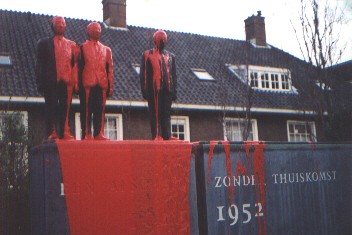
On Thursday March 2, 2000, the Indië monument in Leyden had blood red paint poured over it. This action was claimed by the Comité Stop eerbetoon aan kolonialisme (Committee Stop honoring colonialism) in a letter send to De Fabel van de illegaal. The text speaks for itself.

We are angry because the Leyden city council honors the Dutch soldiers who have together murdered more than 100.000 Indonesians. That's why we have poured blood red paint over the Indië monument in Leyden. Two days before the statues were revealed last year on October 23, 1999, action group Merdeka threw them in the moat. According to their press statement they did so out of protest against Dutch colonialism. We agree with them.

This scandalous monument, near windmill De Put, has to go. More than 100.000 Indonesians they have killed! Just as many as all inhabitants of Leyden. Men, women and kids, whole villages were eradicated by the Dutch army.

What would the many Indonesian surviving relatives think and feel when they hear that the Netherlands have again (there are now about 175!) erected a monument to honor the murderers of their families and friends? And why would chairman Brouwer of the Stichting Militair Indië Monument and the council of Leyden both all the time only speak of the Dutch surviving relatives? With their typical colonial haughtiness they still, 50 years later, do not care a damn about justice. Has nothing changed?

We are not involved in any politics, Brouwer argues. His foundation would only honor the dead. All right, everyone has the right to grieve and should be allowed to remember their family and friends. The dead of every human has to be regretted. But by forcing a monument for colonial murders up our throats, Brouwer and the council take this remembering out of the private atmosphere and make it into a political thing. They want to forever confront the other inhabitants of Leyden with their choice to remember the colonial murderers and not their victims.

The foundation even shamelessly choose to put a sign on the monument saying "Order and Peace". But that was the slogan used to justify the "police actions". This colonial lie was written in stone by the artists who produced the monument without any criticism at all! It is unheard of! Brouwen and his friends still spread exactly the same colonial lies after 50 years!

But we refuse to remember the colonial murderers, and will not rest before the monument has disappeared from our city!


3. Action by Committee "Indië-monument wordt Anti-Slavernij Monument"
(published in De Fabel van de illegaal no 43, January/February 2001)

On December 6, 2000, the committee "Indië-monument wordt Anti-Slavernij Monument" (Indië monument becomes anti-slavery monument) began disassembling the Leyden pro-colonial Indië monument. According to J.W. Werter of Leyden's foundation Indië Monument the activists do not know what the "police actions" really meant. "We never went over there to restore colonialism. On the contrary. I think that every people has a right to independence. Keeping freedom from a people is bad, but giving freedom to a people who cannot manage yet, is criminal", Weter said. His monument was already attacked twice. Two days before it was to be revealed action group Merdeka threw the statues in the water, and later it was poured over with blood red paint by the committee Stop honoring colonialism. Here's the complete press statement of the latest action.

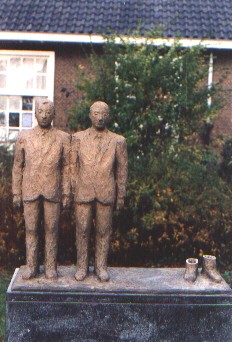
In the early hours of December 6, 2000, members of the committee "Indië monument becomes anti-slavery monument" started the disassembly of the controversial pro-colonial Leyden Indië monument near windmill De Put. The first of the three statues has been removed. The others will soon follow. Afterwards three new statues will be placed, of Present, Mentor and Kodyo. They were slaves in Surinam who escaped their Dutch masters in 1832. Only to find out that they had nowhere to go in the slavery drenched Dutch colony. That's why - in their struggle against slavery - they set fire to large parts of Paramaribo, Surinam's capital. The three men were caught by the barbarian Dutch colonial regime and were burned alive! To set an example. Slavery had almost come to an end in the surrounding countries. Slave trade had been forbidden for already 25 years, and only two years after the deaths of the three Surinam hero's England ended slavery altogether. Dutch slaves had to wait for freedom for another 31 years! By converting of the monument into an anti-slavery monument our committee wants to honor resistance against colonialism and slavery and no longer the colonialists.

Not friendly types

Unfortunately not everyone in this country is convinced that colonialism is objectionable. That became very clear this spring. Prime minister Kok suggested to officially offer apologies for the colonial wars next time he would visit Indonesia. Veterans heavily protested. According to them, the Netherlands were responsible for Indonesia back then and the army would therefore had the duty to military act against Indonesian freedom fighters, in order to restore Order and Peace (also see the inscription on the Leyden Indië monument). Because those Indonesians weren't the friendly types, said miss Spoor-Dijkema, general Spoor's widow. Furthermore, the Dutch war violence was democratic, want the parliament agreed with it, so they say. Hé, Spoor-Dijksma, do you know who wasn't the friendly type? Your own husband, who murdered tens of thousands of Indonesians with his occupying army.

It all points to veterans still thinking from a complete colonial frame of reference. Democratic? Could Indonesians vote in the Dutch parliament, which agreed (with the exception of the communist party CPN) with the slaughter of over a 100.000 Indonesians? The Dutch population, furthermore, was also not totally in agreement with the war. The political and military leaders of the day surely did notice that thousands of Dutch citizens protested against the "police actions"! And what about the weak excuse of responsibility for Indonesia? Veterans, finally wipe the shit out of your eyes: The Dutch were just an occupying force. Occupiers who - after hundreds of years - were replaced shortly (1942-1945) by the Japanese. But according to the veterans both occupiers may not be compared. The Dutch should not be making excuses, but the Japanese should!

Bribe-prince

To calm them down, prime minister Kok assured the veterans that the Japanese crimes have indeed been far worse than our "excesses". The veterans do not have to be afraid: the now hundreds of monuments show that their horrible past is not really going to be discussed. In 1988 the former nazi and bribe-prince Bernard revealed the national Indië monument in Roermond, which has become a place of worship for those who still believe the myth of the good colonial motherland. And yearly new monuments are erected, like those in Leiden en Utrecht. Furthermore, regularly veterans are being rewarded for their deeds, like recently when Leyden's mayor Postma gave a medal to a wounded Indië veteran.

No, we should rather see Kok's plan to apologize in the light of foreign trade relations. It surely was no coincidence that he suggested apologies when minister Jorritsma was visiting Indonesia together with the Dutch business elite. And for that matter: apologies do not mean that much. When queen Beatrix visited Indonesia 5 years ago, she went no further than to say that she was exceptionally sad about the past. (And she took great care to only arrive in the former colony after the 17th of August, to avoid being present at the festivities around the 50th Indonesian independence day.) Kok went further than Beatrix, they say, when he said he regretted the way things went back then. Bullshit. The're just discussing whether to offer 0,0001 percent apologies more. It all means nothing.

Jubilant atmosphere

But offering vague apologies, without really addressing the problem, like colonialism, nowadays is part of modern leadership. Political leaders like Kok have a strategy to distance themselves very carefully from outdated ways of exploitation and oppression. This strategy has the great advantage to implicitly justify current ways of exploitation and oppression. In this way, people in power applaud the current world order - and themselves. Like there are no more wars now, no more poverty, persecution or neo-colonialism. Also - and Kok is very aware of this - offering apologies allows modern politicians to show of as moral leaders. In the past leaders kept their people quiet by promising that everything would get better in the future. But most people do not believe so any more. For the liberals have decided that the end of the ideologies and history has been reached. Society is supposedly almost perfected, and almost everybody is supposed to be very affluent and happy. But forget it! The happy faces of the leadership highly contrasts with the daily reality of millions of people all around the world, including the Netherlands. The leadership also knows that, and the culture of offering apologies is like a perfect public relation gift.

The methods of oppression and exploitation have always changed, in order to react to the resistance from below, and, not to forget, to the competition of other colonial states. Through the centuries the Dutch thieve state has enslaved, bound and beaten it's colonies in different ways. It started centuries ago when Dutch traders and colonists started using people as cattle. In the nineteenth century the Cultivation System was introduced in Indië, which meant an economic straightjacket for millions of Indonesians. The Dutch often used extreme military power, like during the Atjeh War. And after sovereignty was handed over to the Indonesians in 1949, Dutch corporations kept exploiting the Indonesians through institutions like the IGGI and through continuous delivery of weapons to the fascist Suharto regime. In 1949 the Dutch government also handed the Indonesians the total Dutch Indies state debts, some 6,5 billion guilders (3 billion euro). The social democratic patriarch Drees even billed them for the "police actions"! Imagine that the Dutch would have had to pay for the occupation by the Germans during the Second World War. That would be - justly- considered ridiculous. But when it's about a former colony from which one has been plundering and stealing for centuries, the Dutch government had the population simply pay for all Dutch costs of the occupation and war. Incredible, but true!

Forced labor

The Dutch were famous for organizing their colonial exploitation and domination with extreme violence, just like with the draconian Cultivation System in Indonesia. And the Dutch are still up front modernizing and optimizing the neo-colonial exploitative relations, for instance through the European Union and the neo-colonial WTO.

In slavery, the Dutch were also an example of harshness. In the Netherlands there was hardly any protest against slavery, and the end of the Dutch slave trade and slavery as such was more or less enforced by foreign powers. The Dutch state ended slavery only a generation after the surrounding countries did. They just didn't want to spend money on it. Abolition would only be organized when the exploitation of Indonesia - through the Cultivation System - had produced enough money to compensate the slave owners (not the slaves!) financially. And after their 'liberation' the 45.000 former slaves first had to do forced labor for 10 years on the same plantations on which they had been kept as slaves. After that the Dutch abducted tens of thousands of men, women and children from India and Java to Surinam to take the places of the slaves and to work as forced laborers. This form of slavery existed until well into the twentieth century.

The political situation in Indonesia differed from time to time, but the oppression and exploitation by the Dutch remained. The essence of the power relations and the raw reality of poverty and powerlessness of the large majority of the Indonesians still remains. And that's why all ministers, presidents and popes who nowadays offer apologies never say anything about the methods with which oppression and exploitation are organized today. That's logical, because the basic relation of oppression and exploitation is never to be changed, if it's up to them.

Keti koti

The current political leaders love the apology craze. But that doesn't mean that the people who embody the earlier ways of exploitation and oppression, and who did the dirty work back then, like the veterans, are in any danger. Only after a regime change will they be taken to court, like it happened to former Stasi employees. But there has not been any regime change in the Netherlands. Prime minister Kok's apologies may cause large tensions in veteran circles, but they can rest assured: the Liberals and Social Democrats of the Third Way, which are responsible for stabilizing the current neo-colonizing relations, will take good care of the former generations. But of course Spoor-Dijkema and her cronies cannot play any significant role anymore in current politics, and unfortunately they do not seem to realize that. The veterans are no powerhouse anymore, there place has been taken by the political leaders who think they can erase the current injustices from history by offering their hypocrite apologies about injustices from the past. Well, that's not going to happen, when it's up to us!

But the offering of apologies is not completely void of any meaning. It is of course also a sort of answer to the current struggle of the former colonial subjects from Indonesia, Surinam and the Antilles. The struggle in the Netherlands and in the former colonies for recognition of the colonial injustices. And here we are of course not talking of a movement of boring historians: the struggle for the interpretation of the past is also a struggle to raise their current societal position, which is still far from equal. The struggle for anti-colonial museums, for anti-slavery monuments, for anti-racist and anti-colonial education, and for the recognition of remembrances like Keti Koti (The day of the broken chains, the remembering of the abolition of slavery, which was 137 years ago on July 1, 2000) are a way of struggling against neo-colonialism, a way which some of the victims choose today. Only in this light apologies and a monument will not become political tokens.

That's why it's important for all progressive people to support the struggle of organizations of people from Surinam and the Antilles for an anti-slavery monument. And we also demand a beautiful monument for the Surinam liberation activist Anton de Kom, who strongly wrote against slavery in his book "Wij slaven van Suriname" ("We slaves from Surinam"). A monument which clearly shows his struggle against exploitation, racism and fascism. Whilst the Netherlands are covered with dozens of pro-colonial Indië monuments, there's no anti-slavery or Anton de Kom monument. (Note from 2006: there are now.)

Colonial monuments which do not show any anti-colonial or anti-racist thought, should be erased from the earth, like the Van Heutsz monument in Amsterdam. Van Heutsz ordered massive slaughter during the Atjeh War, and he should therefore no longer be honored with his pro-colonial monument. There has been resistance against his monument, ever since the plans to erect it in 1928. The monument has often been targeted by anti-colonial activists. Let's get rid of it! Fortunately, the Amsterdam neighborhood council Oud-Zuid is planning to reshape it. Our proposition: use the monument to remember the resistance against Dutch colonialism. Better late, than never.

Long live Kodyo, Present and Mentor!

With friendly greetings,
Committee ""Indië-monument wordt Anti-Slavernij Monument"


4. Action by action group "Hulde aan weigeraars"
(published in De Fabel van de illegaal no 46/47, Summer 2001)

For a fourth successive time activists have attacked the Leyden Indië monument. De Fabel received this press statement.

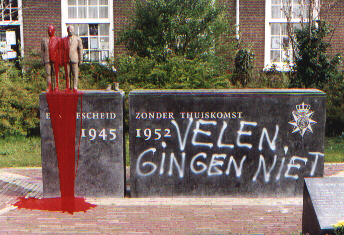
On April 24, 2001, members of the action group "Hulde aan weigeraars" ("Honor the conscientious objectors") have changed the Leyden Indië monument into a monument for conscientious objectors. It has been given a new text: "Velen gingen niet" ("Many didn't go"). For some time now one of the three little soldiers of the monument has been missing. (It was taken off by action group "Indië-monument wordt Anti-Slavernij Monument"). His absence will be symbolic for the men who refused to go, for they didn't want to participate in the massive slaughter of more than 100.000 Indonesians. The two remaining soldiers, symbolic for those who did go, were poured over with blood red paint.

From 1946 to 1949 thousands of conscripts refused to go to Indonesia in order to restore colonial power. Many just didn't turn up, and started to hide themselves from the authorities. Many of them were caught later and were shipped with violence. Others were put in jail for extremely long times. In total, the government gave 1.500 years of jail sentences to the conscientious objectors. In 1946 almost half of the Dutch population was against the war in Indonesia. Even after the war had ended, the repression against the objectors continued. Many former SS member were released early, but not the objectors. Even decades later, the Indië refusers were called criminals. These brave men (and their families) who wanted justice were caused a lot of sorrow. If there's one group who deserves a monument, it's these refusers, and not the military who participated in the colonial slaughter in Indonesia. But there are no monuments for the Indonesia refusers, in contrast to the many colonial monuments all around the country.

We will let the Indonesia refusers speak for themselves. These quotes are taken from the book "Er waren er die niet gingen" ("There were those who didn't go") written by Henny Zwart in 1995. First conscientious objector Fred Bergfeld: "When we refused in 1946 to fight in Indonesia, threats were uttered. Read the speeches of general Kruis. We were to be socially destroyed. For some of us that threat actually materialized. Until today. As refuser you are confronted with the other side of the medal, that it is still allowed to publicly insult and threaten Indonesia refusers today. Thousands of conscripts refused to go back then. Many of those boys were caught and punished, but some of them they didn't get. They went abroad to build a life over there. And then you read in publications that just a few refused. The one says hundreds, the other thousands. But I know that initially in barracks up north whole dorms turned out to be empty, because boys didn't return from their last leave. The military police had lots of work getting these first refusers from their homes and forcing them to join their divisions. And then they went, together with SS men who could loose their sentences by serving in Indonesia. They were of course the pets of the army leadership, because those guys had learned their trade at the Eastern Front. When you read or hear apologies from government people you could say: we seem to have been right back then. You can be proud of that. But we have lived in hell for years for that. Many of the boys who were caught or who have turned themselves in, have been punished incredibility sever. Being in jail for 2 to 5 year is heavy. Half a year is too much, for that matter. They went to court until 1958. But even when you were released, it wasn't finished. I have said once: "I've carried the refusal on my back like a bump." And that's because the period of decolonization is still taboo."

Not only the conscientious objectors themselves were the target of criminalization, their families also suffered. Ida Oerlemans, married to Fred Bergfield: "In 1952 most people had put that rotten war behind them. We could only start then. Fred had been hiding until 1952. Only after he had turned himself in, served his time in jail and afterwards in the army, we could start building ourselves a family. In 1953 things became a bit more normal for us. That was unfortunate, because almost everyone had had a chance to build something in those 7 years, a job, a home, and we stood there with empty hands."

Many conscientious objectors were forced to hide. They sometimes stayed with the same people who had harbored Jews in their home during the Second World War. Refuser Jan van Luyn: "Next morning I went to Amsterdam. To a contact address of the Dutch Military Union of which I already was a member, because I knew they were against the war in Indië and aided refusers. The office was in a cellar in the Linnaeusstraat in Amsterdam. It was crowded. All conscientious objectors. If the military police would have turned up, they would have had a great catch. A guy brought me the Spaarnedammer neighborhood. At one place I could sleep, at another eat. They were people who had already taken Jewish refugees in their homes before 1940. During the entire war they had harbored Dutch Jews. And then I came. After my arrest by the military police in 1950 these people, who became my in-laws that same year, were sentenced for sheltering me. The last period of my sentence I was in Vught. That's a separate story. Just like in Veenhuizen, there were criminals, traitors and murderers over there. Guys I had already met in Veenhuizen, in camp Esserheem. They considered themselves masters of the camp. Some were still wearing their nazi uniforms, but without the insignia. They were extremely privileged, and we were not. They often went to sickbay, to receive their wives. And we knew that most of them had been let go in 1950."

Conscientious objector Dick Kopjes Nieman also landed in the same camp as the Nazi's. "In the Casuariestraat (street) I was locked in a one person cell together with two criminals. Later they put me in a cell with a SS man. That's how sensitive they were. At one point I had to beat up my cellmate, for he was insulting me all the time. He hadn't learned anything. He was still spreading his fascist ideas. In Veenhuizen we got a proposal to work in the coal mines. I came in camp Julia, a part of the jail. There were 20 SS men there. While I was there, they were allowed to leave one by one. When my lawyer asked for me to be let go, that was refused. I also had to work with SS men and NSB men."

Often the same people who had resisted the Nazi's, supported the refusers right after the war. Some victims had to go into hiding for a second time, now to keep out of the hands of the Dutch state. That happened to "Herman Overdiek", who - witnessing the growth of neo-Nazism - even half a century later, still wants to use his nom de guerre he used while in hiding during the Second World War. "As a Jewish boy from Amsterdam I witnessed the repression in all it's ugliness. In June 1942 I was caught for not wearing a Jew star. After my parents were taken away, I was able to survive in our home for some time. I was afraid, lonely and hunted. I had to hide. Our neighbors didn't want to know me anymore, as they were afraid of being arrested by the SD for helping Jews. In 1948, I was just 23, I was called for military service. I had to get ready to go to Indonesia. Then I went into hiding. Again. I wasn't planning to participate in a dirty colonial war. For I could imagine how the people over there would feel under our military occupation. History repeated itself. I was, years after being liberated, fleeing again. Then my wife and I decided to go to Israel, illegally. The histories of the Indië refusers, every one of us have a lot of shocking experiences. It was clear that we had a government which was ruthless against fundamental Indonesia refusers. There was no understanding for what you had been through, whatever your background. But for all hardship we went through, my wife and I, we are proud that they couldn't force us to kneel. We were ahead of our time. I always kept thinking, even at the worst moments, that one day we would be considered right, that it would become clear that the war in Indonesia was wrong."

Terug